Miscellany Vol. I: Karate Champ, Orange Chun-Li, Red Hadoken
Volume I is where the Miscellany begins, with seven entries about where Street Fighter came from and about the little quirks of Street Fighter II.
Where Ryu and Ken came from
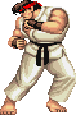
Ryu, Ken and the series around them can be seen as descendants of ideas that Technos tried in the 1984 arcade game Karate Champ. That game gave Street Fighter its side-on view and several other habits: white and red karate uniforms, very specific command inputs, bonus stages, and, in the sequel Player Vs. Player, fights in locations around the world. One of its bonus games even shows Masutatsu Oyama’s bull-fighting stunt, and Mas Oyama, known for his harsh training, is one of the real-life models for Ryu.
Another root is Irem’s Kung-Fu Master (1984), produced by Takashi “Piston” Nishiyama, who later went to Capcom and directed Street Fighter. Speaking for the SF25 art book, he explained that he was already studying martial arts, so he wanted to make games about something he knew.

Chun-Li was almost orange
Chun-Li’s first colour scheme appears to have been orange. On the arcade World Warrior’s character select and result screens she wears orange, even though her in-game qipao is blue, and the outfit she throws off in her ending is yellow-orange. The change to blue evidently came very late. Her portraits were recoloured for the 1992 Super Nintendo port, but the orange look returned the following year as an alternate palette in Super.

The look of M. Bison
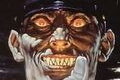
M. Bison looks remarkably like Yasunori Kato, a villain from Teito Monogatari. Early artwork matches even the star on his cap, which was soon swapped for the Shadaloo winged-skull emblem. Given the dates, the 1988 live-action film Tokyo: The Last Megalopolis is probably the version that shaped his design. Other accounts name General Washizaki, “Eagle Cape”, from the Riki-Oh manga. What can be said is that all three characters share many traits.
Real people hidden in the games
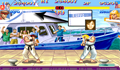
The yacht in the foreground of Ken’s stage from Super onward is named “Buppo”, written on its pilothouse. The older boat in earlier versions lacks the detail because the stage was redrawn. Buppo was a real character artist on Street Fighter II and a long-serving Capcom employee, and his picture appears in the staff credits of World Warrior, Champion Edition and Hyper Fighting if you do not lose a round. In the Merlin sticker album for Super the first letter was somehow airbrushed away, leaving “uppo”.
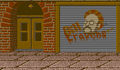
Bill Cravens, whose name and face are graffitied in the Block Heads pub in Birdie’s stage in the first Street Fighter, was vice-president of sales and marketing at Capcom USA. As a distributor he helped revive the arcade business after the 1983 crash, and he is said to have sold one of the first Pong cabinets in the early 1970s. He died in 2007. He is one of very few real individuals to appear in the series, and the most striking other case is Mikhail Gorbachev in Zangief’s Street Fighter II endings.
Who are the fighters in the intro?
The pair brawling in the intro of Champion Edition and Hyper Fighting were long believed to be Joe and Mike from the original game. That would have made them the only characters, aside from Ryu, Ken and Sagat, to feature in both Street Fighter and Street Fighter II. Capcom’s Shadaloo Combat Research Initiative for Street Fighter V later named them Max and Scott.
In the international Genesis/Mega Drive port, Special Champion Edition, Max was recoloured and given a new hairstyle so that he looked white, probably to dodge accusations of racial stereotyping. Final Fight on the Super Nintendo did something similar, lightening the skin of Dug and Simons, and Final Fight 3 did it to a thug named G. It tells you something about how censors thought about race and violence in the early to mid 1990s.
The red Hadoken
A palette glitch in the CPS-1 version of Street Fighter II sometimes makes Ryu and Ken throw red Hadokens, occasionally called golden ones. They are very rare, and the odds are lower than the 1-in-100 figure sometimes quoted. They do no extra damage. People often mix them up with Ryu’s Shakunetsu Hadoken from Super, a fire-based version of the move that probably took its cue from the glitch.
A later update: in late 2013 Akira Nishitani, nicknamed Nin-Nin, began posting development anecdotes on social media. One post revealed that the red Hadoken was not a glitch at all, but a playful touch from the programmer.