Street Fighter II Special Moves List: Classic Characters
Street Fighter II special moves are performed by moving the joystick in a set pattern and pressing a button. The best-known are Ryu’s Hadouken (quarter-circle forward plus punch) and Guile’s Sonic Boom (hold back, then forward plus punch). Each fighter has a handful of such moves, and learning them is the first step to playing the game.
This list explains how inputs work and then goes through the classic cast by move type. Details vary a little between versions such as World Warrior, Champion Edition and Super Street Fighter II, so treat the entries as the standard pattern.
How to read the notation
Inputs are described as directions of the stick plus a button:
- Quarter-circle forward: down, down-forward, forward
- Quarter-circle back: down, down-back, back
- Dragon punch motion: forward, down, down-forward
- Half-circle: a smooth sweep from back through down to forward, or the reverse
- Charge: hold a direction (usually back or down) for about two seconds, then press the opposite direction and a button
- Mash: press a button repeatedly
Punches come in light, medium and heavy strength, and kicks do the same. The strength changes speed, distance or damage depending on the move.
Motion characters
These fighters rely on quick joystick motions.
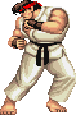
Ryu and Ken
Ryu and Ken share most of their move set, which is why many beginners start with them.
- Hadouken: quarter-circle forward plus punch. A fireball thrown across the screen.
- Shoryuken: dragon punch motion plus punch. A rising uppercut, useful against jumping opponents.
- Tatsumaki Senpukyaku: quarter-circle back plus kick. A spinning kick that moves forward.
The differences between the two are small and change between versions, so check the version you are playing. The World Warrior fact sheet includes the original roster and version notes.
Dhalsim
- Yoga Fire: quarter-circle forward plus punch.
- Yoga Flame: half-circle back to forward plus punch, a wider flame burst.
Dhalsim’s normal attacks reach very far because of his stretching limbs, so his specials are used alongside long-range pokes.
Sagat
Sagat, one of the four boss characters in the original game, uses the Tiger Shot, a quarter-circle forward plus punch, in high and low versions, and the Tiger Uppercut, performed with the dragon punch motion. He became playable in Champion Edition.
Charge characters
Charge characters hold a direction while defending and release for the special. That makes them more defensive.
Guile
- Sonic Boom: hold back, then forward plus punch. A projectile.
- Flash Kick: hold down, then up plus kick. A somersault kick, effective as an anti-air.
Blanka
- Rolling Attack: hold back, then forward plus punch. He rolls into the opponent as a ball.
- Electric Thunder: mash punch. A burst of electricity around his body.
E. Honda
- Hundred Hand Slap: mash punch.
- Sumo Headbutt: hold back, then forward plus punch.
Chun-Li
- Spinning Bird Kick: hold down, then up plus kick.
- Lightning Kick: rapid kick presses.
- Kikoken: a fireball that Chun-Li gained in later versions of the game, not in the original World Warrior. Check the move list of the version you are playing for the exact input.
Grapplers and other special inputs
Zangief is the grappler. His Spinning Piledriver uses a full 360-degree circle on the stick plus punch, and works only when you are close to the opponent. His Double Lariat is a spinning arm attack that works well against jump-ins. Learning to perform the circle quickly while in range is the usual obstacle.
Balrog (the boxer in most regions) uses the Dash Straight and Turn Punch, which rely on charging or holding buttons for a period.
Name swaps: the three boss names are shuffled between Japan and most other regions. In Japan the boxer is M. Bison, the claw-wearing fighter is Balrog and the dictator is Vega; in the West the boxer is Balrog, the claw fighter is Vega and the dictator is M. Bison. This page uses the Western names. Which names appear depends on the version you own, so check before comparing guides.
Putting moves together
Special moves work best as part of short sequences. A common pattern is to jump in with a strong attack, land a quick normal attack and finish with a special move before the opponent recovers. Another is to throw a fireball to force a reaction and then follow with a sweep or throw. Learn one two-hit pattern per character, then practice it until the inputs feel automatic.
Common mistakes
- Not charging long enough. A brief tap on back before forward will not trigger a Sonic Boom.
- Sloppy diagonals. The dragon punch motion fails if the stick skips the down-forward step.
- Wrong button strength. The same move can have very different range and recovery depending on which button you press.
- Throwing fireballs at every distance. Opponents jump over them. Mix with other options.
Next steps
Practice in a training mode if the version has one, or play slowly against the CPU. Compare each character’s cabinet-era data and release details on the Street Fighter III facts page to see how the series evolved the move system. The World Warrior page shows the original eight-fighter lineup.
Frequently asked questions
What is the easiest special move in Street Fighter 2?
The Hadouken is the usual starting point, because the quarter-circle forward motion is simple and the move is useful in many matches.
How do you do a Sonic Boom?
Hold the joystick back for about two seconds, then press forward and a punch button together.
Do the moves change between versions?
Yes, slightly. Damage, speed and sometimes inputs change between World Warrior, Champion Edition, Turbo and the Super versions.
Can I use any button for a special move?
Usually yes, but the button changes the move’s speed, range or damage. Fireballs, for example, travel at different speeds depending on punch strength.